Stainless steel is popular in the jewelry world because of its durability, modern appearance, and resistance to rust. But many buyers are constantly worried about nickel content and its allergic reactions, hence the common question that always pops up: is stainless steel nickel-free?
In this article, we will enlighten you on what stainless steel jewelry is made of and answer whether it has nickel or not.
What is Stainless Steel Made Of?
Stainless steel is primarily composed of iron, with a blend of other metals like chromium, nickel, molybdenum, carbon, manganese, and silicon.
Each of these metals have their functions. For example, chromium creates a protective layer that helps prevent rust or corrosion. While nickel (which is commonly labelled as a bad metal) helps to improve the shine and strength of the stainless steel piece.
These combined elements make stainless steel jewelry highly durable, scratch-resistant, and suitable for everyday wear without losing its appearance.
| Component | 304 SS | 316 SS | Note |
| Iron (Fe) | 66~70% | 64~67% | Main base meta contributes to the mechanical strength |
| Chromium (Cr) | 18–20% | 16–18% | Essential for rust and corrosion resistance |
| Nickel (Ni) | 8–10.5% | 10–14% | Improves the metal’s shine and durability |
| Molybdenum (Mo) | / | 2–3% | Make 316 more resistant to salt, sweat & chemicals |
| Other | Less than 3%(Carbon, Manganese & Silicon) | Improves hardness, durability & oxidation resistance | |
| Nickel Release | Low, but higher than 316L | Very Low | Low release prevents allergic skin reactions |
Does Stainless Steel Have Nickel?
There are 2 major grades of stainless steel used in making jewelry: 304 and 316L. And YES, both of them have nickel. But most people mistake the presence of nickel in jewelry with the release of nickel. Understanding this distinction is important to know what is nickel-free jewelry.
Nickel is intentionally added to stainless steel to improve its resistance to corrosion, boost its structural strength, and enhance its surface finish.
304 stainless steel typically contains about 8-10.5% nickel, while 316L stainless steel contains around 10-14% nickel. The nickel content in these stainless steel types are tightly bonded within the metal structure, significantly limiting its release and ensuring safety.
Is Stainless Steel Jewelry Nickel-Free?
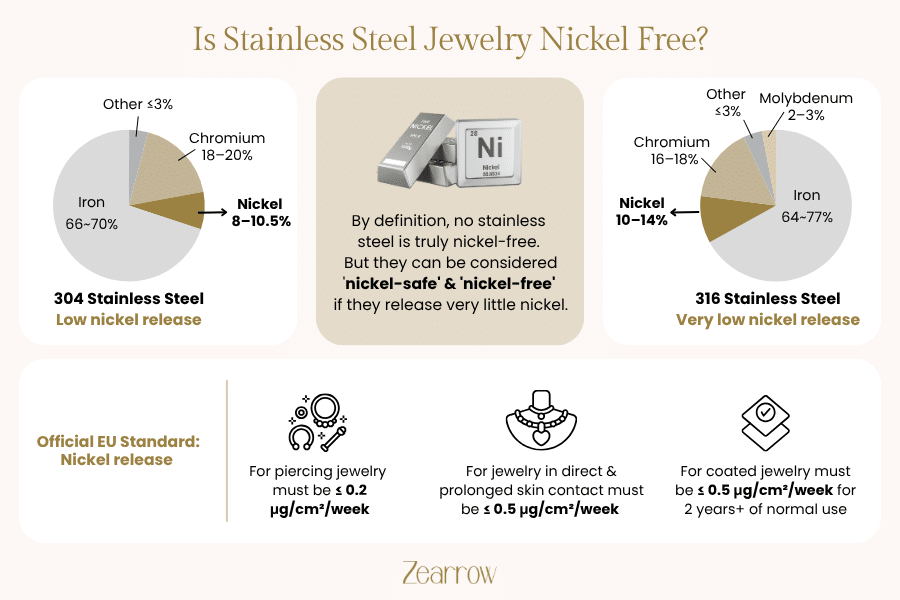
By definition, some people may argue that stainless steel is not nickel-free. But in reality, stainless steel jewelry can be considered “nickel-safe” and “nickel-free” as long as the nickel release is within the European Union Nickel Directive.
According to the Directive, a jewelry is “nickel-free” if the nickel release is less than 0.2 μg/cm2/week (for piercings) and less than 0.5 μg/cm2/week (for other jewelry pieces).
This is what makes stainless steel jewelry special (especially 304 and 316L). 304 stainless steel nickel content release is below 0.3 μg/cm2/week, and 316L nickel release is below 0.1 μg/cm2/week.
Is 316L Stainless Steel Jewelry Nickel-Free?
Wondering, is 316L stainless steel nickel-free? The answer is a resounding YES. While it does contain about 10-14% nickel, it releases less than 0.1 μg/cm2/week, which is exceptionally safe based on the European Union Nickel Directive.
In addition to that, 316 stainless steel contains molybdenum, which is instrumental in preventing corrosion and nickel release.
Without mincing words, 316L stainless steel jewelry is nickel-free and is one of the best option for piercings and people with sensitive skin.
Can You Be Allergic to Stainless Steel?
While stainless steel is generally safe, some people can still experience allergic reactions because of the trace nickel content. This can be caused by their skin sensitivity level, duration of wear, and the stainless steel grade used.
Hence why it’s always advised to go for stainless steel jewelry made with 316L grade. It offers better protection for highly sensitive skin, can be worn for long hours everyday, and less likely to cause reactions.
Is Stainless Steel Jewelry Hypoallergenic?
YES, stainless steel jewelry is hypoallergenic.
NOTE: “Hypoallergenic” doesn’t always mean “allergy-free.” It basically means the metal is less likely to cause irritation.
High-quality grade like 316L stainless steel is considered one of the most hypoallergenic materials used in the jewelry industry due to its stable surface structure. Its durability and resistance to corrosion sets it apart as a safe choice for sensitive skin.
Does Stainless Steel Jewelry Tarnish?
Stainless steel is highly resistant to tarnishing thanks to chromium in its composition. The chromium element forms a thin protective oxide layer that shields the stainless steel metal from extreme conditions that may result in tarnishing.
Learn more about does stainless steel jewelry tarnish and how to maintain its shine.
How to Tell Stainless Steel Jewelry is Nickel-Free?
Below are some professional ways to know if a stainless steel jewelry is nickel-free or not:
- Check Hallmarks and Stamps: A nickel-free stainless steel jewelry will have markings like “nickel-free,” “nickel-safe,” “316L,” or “surgical stainless steel” on its inner surface or packaging. You can also check the product descriptions or manufacturer’s specifications to confirm the material composition.
- Ask for Material Certifications: A professional custom jewelry manufacturer will give you the material certifications to verify compliance with nickel release standards. The certifications will state the stainless steel nickel content and the amount released.
- Use Nickel Testing Kits: A nickel testing kit contains a chemical solution that changes color when put on a jewelry that has nickel. It will help you identify stainless steel jewelry that may trigger allergic reactions.
Conclusion
So, is stainless steel nickel-free? YES, especially high-quality grades like 304 and 316L. Even though they contain nickel, their release rate is very low and doesn’t cause any skin reaction.
Do you have severe nickel allergies or want to wear your stainless steel jewelry for long hours everyday? It’s advisable that you opt for higher-grades like 316L surgical steel. It’s also important that you check for hallmarks, confirm certifications, or use a testing kit before buying.